
5 min readPanoramic Berkeley
Berkeley apartment noise map, block by block
Which Berkeley blocks are actually quiet at 2am, where BART rumbles through walls, and how to tell a soundproofed building on a tour.
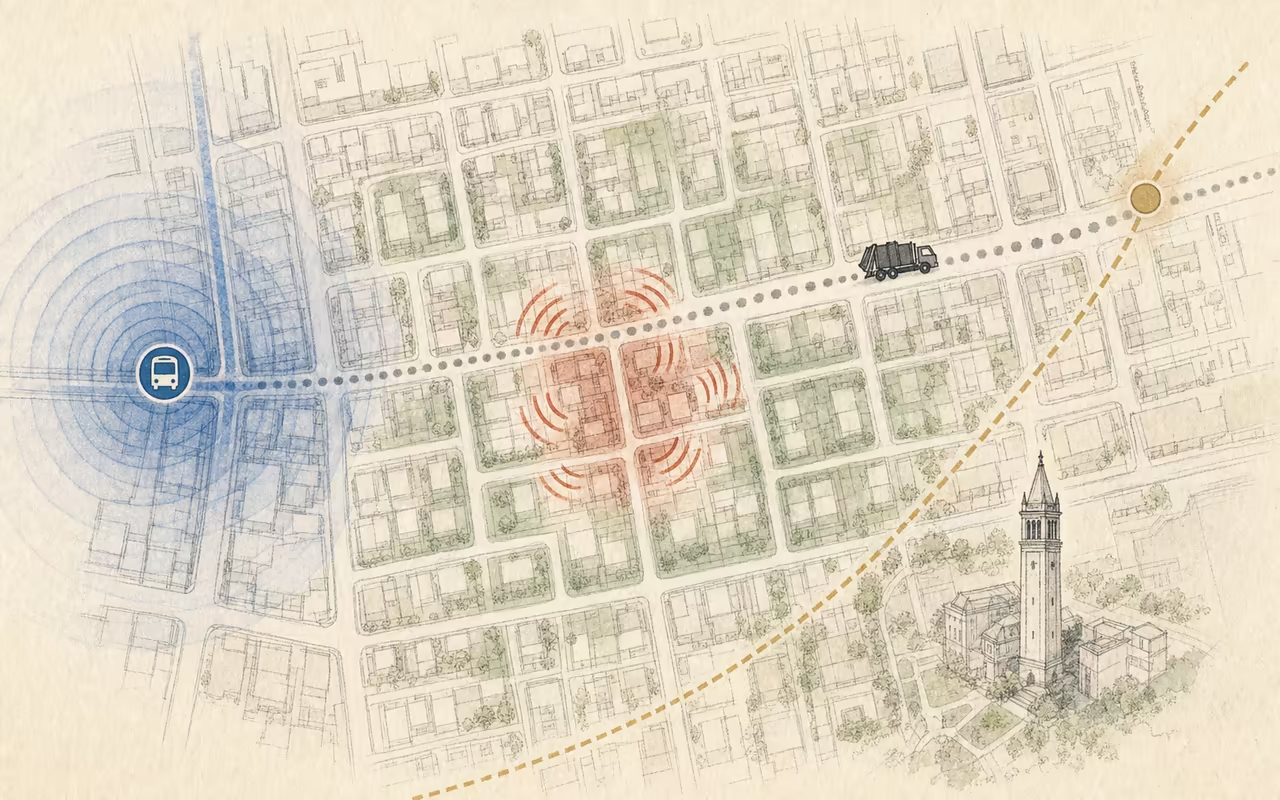
Renters ask about noise more than anything else, and they almost always ask about the wrong thing. Every parent I tour with brings up BART. Every other student worries about traffic on Telegraph. Both concerns skip past the sources that actually keep people awake at 2am in Berkeley.
Fifteen minutes on a tour, with your ears open, will tell you almost everything. The rest of this is where to listen.
The BART myth
Berkeley students inherit a fear of BART from older siblings at Rockridge or MacArthur, where the trains run above ground. Inside Berkeley city limits, BART is a subway the whole way. Downtown Berkeley: subway. Ashby: subway (South Berkeley won that fight in the 1960s, largely because of a community organizer named Mable Howard). North Berkeley: subway too. The city passed an extra bond measure to bury the line.
So if the apartment you're touring sits inside Berkeley, BART rumble is a non-issue. Ground-floor units directly over the Ashby tunnel might catch a faint vibration. Almost nobody else will. The tracks don't resurface until El Cerrito Plaza to the north and MacArthur to the south, and neither is near an apartment a Cal student would tour.
Save your worry for something that actually reaches you at 2am.
AC Transit and the 5am start
The 51B is a great bus. It's also a diesel bus that starts at five in the morning, seven days a week, and the first run leaves Rockridge BART at 5:00 sharp on weekdays and 5:03 on weekends. If your apartment sits within a block of College Avenue between Rockridge and Bancroft, or on Bancroft or Durant between Piedmont and Shattuck, the first pass rolls by around 5:13 to 5:20. That's your alarm clock.
The 51B runs 173 scheduled trips a weekday, roughly every five to eight minutes at peak. Noise concentrates at the stops: brake hiss, accessibility beep, diesel idle. Apartments on the same block as a stop get all of it. Apartments a hundred feet off the corner get almost none.
Check the F transbay too. Same early hours, cutting through Downtown Berkeley on University.
Greek Row and the weekend problem
The heaviest social noise in Berkeley sits on a small handful of blocks. Piedmont Avenue between Bancroft and Dwight, and the two or three blocks of College immediately south of Bancroft, sit closest to the fraternity houses. Warring and Prospect catch spillover, and so does the upper stretch of Channing near the Greek Theatre. Football weekends and rush weeks are the loudest.
If you plan to sleep before 2am on Fridays for the first six weeks of fall semester, don't sign a bedroom facing one of those streets. Every fall I get a call from a Southside student who took a room with a great view and didn't stop to think what was under the window.
Elmwood south of Ashby, Northside above Hearst, West Berkeley: far enough away that this doesn't reach you. It's one of the reasons grad students and faculty tend to pick Elmwood over Southside.
Garbage, recycling, and street sweeping
Berkeley residential streets get swept once a month, not once a week like San Francisco. Once you know the day, it's just a Tuesday morning to move your car. The garbage and recycling pickup catches more renters. That runs weekly, starting as early as 6am on some routes. Compactor trucks are loud. Glass recycling into an empty bin is louder. If your bedroom window is over the alley or curb where your building sets out its bins, you'll hear it.
You can look up your specific block's sweeping day on the City of Berkeley website by address. For garbage, ask a current resident. Anyone who's lived in the building for more than a month knows exactly which day and which side of the street.
Delivery trucks on Telegraph and Shattuck
Retail spines restock overnight. On Telegraph between Bancroft and Dwight, and on Shattuck from Center up through the Gourmet Ghetto, large trucks pull into loading zones between 4 and 6am, five or six days a week. Pallet jacks on sidewalks. Roll-up doors on the back of a bakery. Rent above any of it and the truck is your alarm clock, not the traffic.
On a tour, walk the block twice. Once at 8pm, once at 7am the next morning. Look for loading zones and roll-up gates. If any of them sit directly under your bedroom window, take the trade seriously.
The 15-minute tour
You can catch most of a building's noise problems in under fifteen minutes.
Knock on the wall between the bedroom and the hallway. A hollow wood-frame wall thumps back with almost no resistance. A double-drywall wall with insulation sounds duller and heavier. The dull one is what you want.
Have someone stand in the bedroom and talk at normal volume while you close the hallway door. If you can still hear them clearly, the door has no gasket and the wall isn't insulated. You'll hear their phone calls at midnight too.
Count the window panes and look for the gasket. Single-pane glass with no gasket is standard old Bay Area stock. Double-pane with a rubber seal cuts most street noise. Newer buildings often use laminated double-pane, which is quieter still. Concrete-and-glass buildings are the quietest option here.
Open the window and listen for thirty seconds. That's what your bedroom actually sounds like. Traffic, bird noise, HVAC drone on the roof next door, the neighbor's kid learning trumpet.
Check where the HVAC condenser sits. If it's on the roof directly above your ceiling, you'll hear it every time it cycles on. Well-designed buildings put condensers over hallways or common areas instead.
Which Berkeley blocks stay quiet
The quietest picks near campus are Elmwood south of Ashby (especially the interior streets off College) and Northside above Hearst (especially west of Euclid). West Berkeley residential streets set back from University and San Pablo work too, with the tradeoff of a longer walk to Sather Gate.
Southside and Downtown are louder by design. It's the trade for a five-minute walk to class. If you want to sleep on Southside, get a unit set back from Telegraph and Bancroft by at least one block, in a modern concrete-and-glass envelope. That's the intersection our Panoramic buildings sit in.
If you want a visual, our interactive Berkeley noise map puts the same block-level sources on a schematic with filter toggles. Our neighborhood guide to Southside, Northside, and Elmwood covers the daytime character of each. Both are worth reading before your first apartment tour of the season.
Verified July 2026.